
Why do enemies act mid-hand?
Their Time Counter hit zero while you were still playing cards. Cheap setup and lane swaps exist to prevent that window.

Shards of Order combat guide: read enemy time counters, wind clocks with each card, manage Grit & positioning on a shared deck. Verified July 2026.
Shared-deck time counters, hero kits, and revive pressure.
~6 min read
Sponsored
This Shards of Order combat guide explains the countdown loop that replaces classic turns and mana. Enemies act when their visible time counter hits zero, and every card you play winds those clocks. Verified August 16, 2026 · Fardust / Awaken Realms · Steam.
| Fact | Detail |
|---|---|
| Turn model | No classic enemy/player phases — visible Time Counters |
| Card Time Cost | Roughly 0–8 on the card corner |
| Party | Warrior · Exile · Scholar on one shared deck |
| Defense | Grit / Shield · lane swaps · Weakness |
| Panic button | Ethereal Power once per fight |
| Platform | Steam (Windows · Steam Deck Playable) |
| Price | $9.99 |
Each enemy shows a Time Counter. Playing a card advances those clocks by the card’s Time Cost. Cheap cards let you stack setup; expensive finishers can hand the board back to the enemy mid-combo.
| Signal | What it means | Player response |
|---|---|---|
| Counter near zero | Enemy acts soon | Grit / swap / Weakness first |
| High Time Cost card | Clocks jump hard | Only after shields or kills lined up |
| 0-cost chip | Almost free advance | Use to finish Redraw discount |
| Enemy time bump cards | Push their clock up | Buy a free action window |
| Multi-enemy board | Several clocks ticking | Focus the buffer / backline first |
A “safe window” is any stretch where no counter will hit zero before your next two cheap plays. If two enemies sit at 1–2 Time, stop greed damage and stabilize.
Shrike telegraphs lane hits on the same counter UI. Practice the habit on trash packs, then apply it on the Shrike fight.
Next: Redraw cost is part of the same economy.
Opening Redraw costs about 4 Time. Spending cards that total 4 Time makes Redraw free again. Spamming Redraw early is how beginners feed enemy clocks for nothing.
Build lines that naturally spend 4 Time: Grit into Weakness into a 1-cost strike, then cycle. That pattern beats “Redraw until I see my nuke.”
Some items and last-card effects want an empty hand. Learn those after the core loop — do not empty the hand just because a tooltip mentions it once.
Defense and lanes decide whether your sequencing even matters.
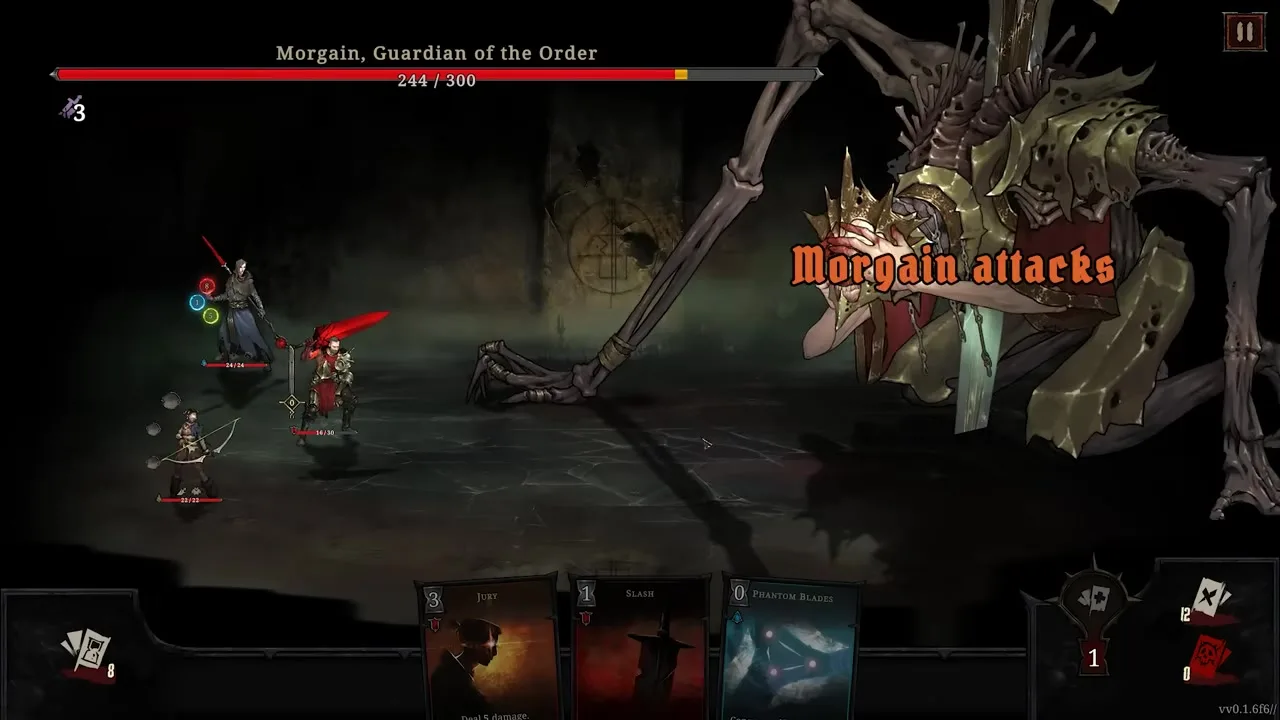
Grit and shield effects turn a punish window into a shrug. Enemies target positions, not permanent hero IDs — swapping is a core defense tool.
| Tool | Cost / catch | Best use |
|---|---|---|
| Grit / Shield | Time cost on the card | Before a known lane hit |
| Lane swap | Usually 1 Time | Move Warrior onto the threatened tile |
| Momentum | Buff-dependent | Makes swaps free while active |
| Weakness (Exile) | Needs draw access | Multi-hit packs and Shrike |
| High HP soak | Risks Fracture if you misread | Only when shields are empty |
The UI shows which position will eat the hit. Swap first, then spend leftover Time on damage. Swapping after the counter hits zero is too late.
Lev’s kit stacks Strength and Rage while holding Shield. Park him on the glowing lane, keep Exile and Scholar off the spike, then continue the shared-deck plan.
Shared-deck pitfalls are next — they silently undo good clock play.
Matched by build plan, shared topics, and guide progression — not random related links.
Downed heroes convert their cards into Revive cards at 1 Time each, restoring roughly half HP. Each revive path can Fracture the fight — Redraw then damages everyone based on the Fracture number (commonly 6 → 12 → 18 style steps).
| Option | Upside | Downside |
|---|---|---|
| Revive cards | Cheap, always available | Partial heal · builds Fracture |
| Ethereal Power | Full revive + party heal + Ethereal card | Once per battle |
| Ignore the down | Save Ethereal | Lose that hero’s kit and lane coverage |
Burn Ethereal when two heroes are down or one key hero dies with a lethal clock already armed. Do not spend it on the first chip-down in a long boss.
Some true-ending routes discourage heavy Ethereal use. If you care about that branch, lean on positioning and Weakness instead of panic buttons — confirm in your journal / ending notes as you approach the finale.
Target priority keeps you from needing either button.
Buffers and backline supports usually die before fat frontliners. Tanks exist to waste your Time while clocks arm behind them.
Their Time Counter hit zero while you were still playing cards. Cheap setup and lane swaps exist to prevent that window.
No global mana bar. Scholar builds coloured mana from the cards you play, but the board economy is Time first.
Trash packs in Shrike’s Lair, then the Shrike boss. Card priorities: best cards. Role kits: characters.
Matched by build plan, shared topics, and guide progression — not random related links.